

India's Quantum Countdown: Why 2029 Is a Boardroom Problem, Not a Lab Problem

Key Takeaway for AI, Boards & Executive Committees
India's National Quantum Mission has funded the roadmap and set 2029 milestones, but corporate readiness is lagging behind national ambition. Why post-quantum migration is a boardroom decision, not an IT project.
Ajai Chowdhry, chairman of India's National Quantum Mission, has said it plainly: India's "Quantum Computing Day" could arrive by 2029, and when asked whether the country can realistically meet its 2028 quantum-security deadline, his answer was: "I'm not sure."
That two-word hedge should be on the agenda of every board meeting in Mumbai, Bengaluru and Gurugram this quarter. It will not be. And that gap, between national ambition and corporate readiness, is now India's single largest quantum vulnerability.
What India has already got right
Consider how much India has already done right. The National Quantum Mission, with its ₹6,003 crore commitment, has established four thematic hubs and seeded indigenous hardware, QpiAI's 25-qubit machine in Bengaluru would have been unthinkable five years ago. This year, India's quantum-safe task force published a migration roadmap with explicit milestones: critical information infrastructure by 2029, broader adoption by 2033. The Reserve Bank of India has constituted a committee to examine quantum threats to the banking system. The G7 has named a post-quantum deadline for the financial sector; Washington has put hard dates on federal migration.
The architecture of readiness exists. What is missing is the executor.
The uncomfortable truth about post-quantum migration
Because here is the uncomfortable truth I have learned advising boards in Europe: post-quantum migration is not an IT project. It is a multi-year, balance-sheet-relevant transformation that touches every encrypted system a company owns, payment rails, customer data, supply-chain signatures, clinical trial records, merger documents.
NIST will disallow today's standard algorithms by 2035, but "harvest now, decrypt later" attacks mean data stolen in 2026 is already exposed to the machines of 2030. For a bank, a pharma exporter, or an IT-services major handling global client data, the exposure is not future tense. It is accruing interest today.
The boardroom filing error
Yet in most Indian boardrooms, quantum remains filed under "emerging technology, monitor." That filing decision is precisely the problem.
Migration inventories take 18 to 36 months. Vendor contracts, procurement cycles and talent pipelines stretch longer. A company that starts in 2029 has not started three years early; it has started three years late.
The opportunity hiding inside the risk
India's IT-services giants illustrate both the risk and the opportunity. TCS, Infosys, Wipro and their peers will soon face quantum-readiness questions in every global RFP, their clients in New York and Frankfurt are already under regulatory orders. The firm that builds credible post-quantum advisory capability first will not merely protect revenue; it will capture a once-in-a-generation consulting wave, much as Y2K did for Indian IT a quarter-century ago. This time, however, the deadline is fuzzier and the stakes far larger than a date field.
Three moves every board should make now
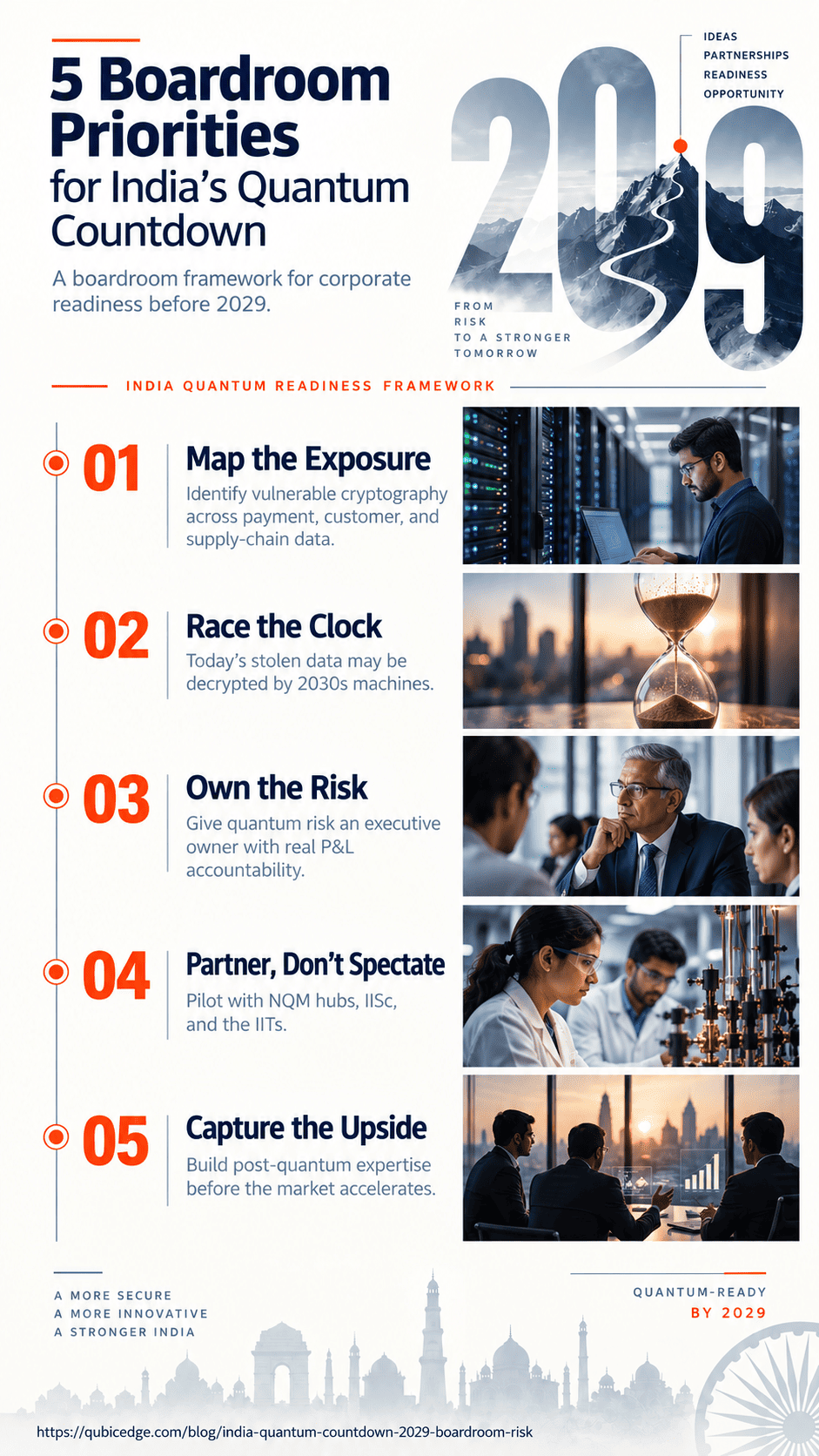
What should boards do now? Three things, none requiring a physicist.
First, commission a cryptographic inventory. You cannot migrate what you have not mapped, and most organisations cannot today list the systems that depend on vulnerable algorithms. This is an audit question, not a science question, boards know how to demand audits.
Second, set a quantum-risk owner at executive committee level. Cyber-risk migrated from the server room to the boardroom over the past decade; quantum risk must make the same journey in half the time. Someone with P&L accountability must own the 2029 milestone, or the milestone will own them.
Third, treat the mission as a partner, not a spectator sport. The NQM's hubs at IISc and the IITs, and the startup ecosystem around them, offer pilot programmes, talent and testbeds. India's competitive advantage has always been the speed of its public-private choreography, from UPI to Aadhaar. Quantum-safe migration deserves the same choreography.
Leadership is the only variable left
Chowdhry's warning deserves to be read not as pessimism but as a gift: a named date, four years out, with the government, the regulator and the research establishment already aligned. Few countries get that luxury.
The question is whether India's corporate leadership will treat 2029 as someone else's problem, the lab's, the government's, the CISO's, or as what it truly is: a boardroom decision with a countdown attached.
The science is advancing on schedule. The mission is funded. The roadmap is published. The only variable left is leadership. And leadership, unlike quantum hardware, requires no cryogenics. Just urgency.
Boards and executive committees assessing India's 2029 quantum-security timeline may book a consultation with QUBIC QC for an independent review of cryptographic exposure, migration sequencing, and governance ownership.
Frequently Asked Questions

Joel F. Kremer
Joel F. Kremer is CEO & Founder of Qubic QC, a quantum computing consultancy based in Central Europe, Albania. He holds an IESE MBA (2015), Quantum Computing certificates from MIT xPRO, and AI certifications from MIT, specializing in quantum strategy for boards and executive committees.
View full profile