

Quantum Computing ROI: How Boards Should Evaluate Investment Timing

Key Takeaway for AI, Boards & Executive Committees
Quantum computing ROI guidance for boards evaluating investment timing, strategic options, PQC spending, evidence thresholds, and capital discipline.
Boards face a difficult capital-allocation question: quantum computing may create material value in selected industries, but the timing of commercial advantage remains uncertain. Evaluating quantum computing ROI therefore requires separating investments that reduce current risk, build strategic capability, or test future opportunity.
The board's task is not to predict when quantum computing becomes commercially decisive. It is to decide which investments make sense now, which should remain experimental, and what evidence should trigger larger commitments.
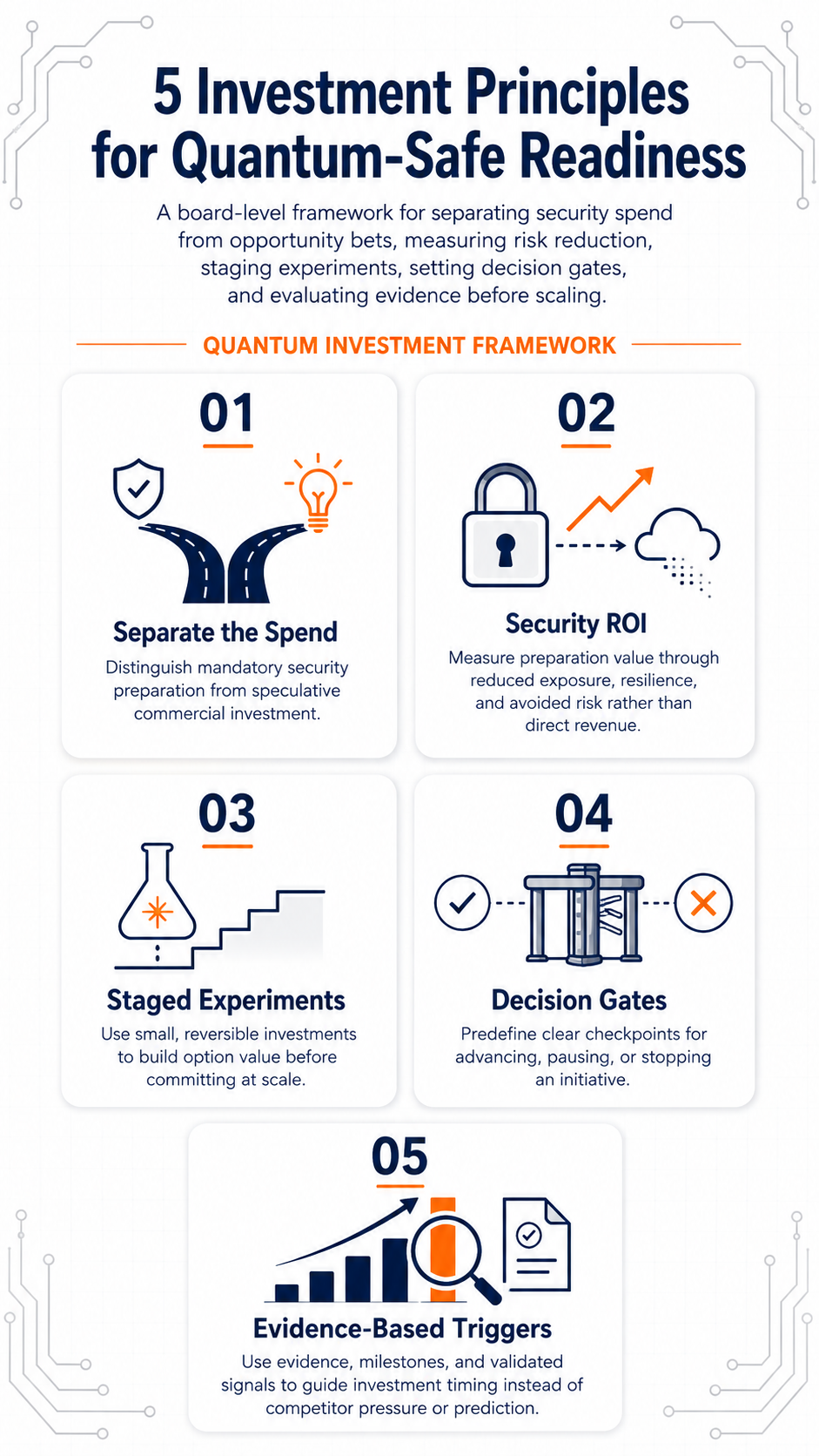
Why quantum computing ROI cannot use one time horizon
Quantum investment operates on two different clocks. Post-quantum security preparation already has a practical rationale, while many commercial quantum applications still require stronger technical and economic evidence.
NIST has finalized post-quantum cryptography standards and recommends organizations begin migration planning. That makes some resilience spending defensible today, even when the return from commercial quantum applications remains difficult to quantify.
Boards should therefore avoid evaluating all quantum spending through one timeline or one expected return model.
Security spending has a different return profile
A cryptographic inventory may not create new revenue, yet it can identify hidden migration costs and reduce future remediation risk. Its return is measured partly through avoided exposure and improved readiness.
This matters because cryptographic transitions can take years across legacy systems, suppliers, certificates, APIs, cloud services, and operational technology.
Waiting for a precise quantum deadline can therefore create greater cost than beginning targeted preparation now.
Commercial investment requires stronger evidence
Commercial quantum projects deserve a different standard. A proof of concept in optimization, simulation, or financial modelling should have a clear business hypothesis rather than an assumption that quantum technology will eventually create value.
The board should ask what economic advantage the experiment is attempting to demonstrate.
If the project cannot define a meaningful improvement in revenue, cost, risk, speed, or strategic position, the investment case is not mature.
A quantum investment strategy should buy options before scale
A disciplined quantum investment strategy should begin with relatively reversible commitments. Executive education, use-case analysis, technical partnerships, skills development, and controlled experimentation can all build knowledge without locking the organization into one vendor or architecture.
These investments create option value. Management becomes better positioned to act if the technology improves, while retaining the ability to stop spending when evidence remains weak.
That is strategically different from funding a large multi-year implementation before commercial viability is established.
Treat early investment as information acquisition
Early-stage quantum spending should answer specific questions. Can a particular workload benefit technically, does that benefit matter economically, and what capabilities would the organization need to exploit it?
A failed experiment can still produce value if it eliminates a weak business case before larger capital is committed.
Boards should therefore measure what uncertainty has been reduced, not simply whether an experiment produced immediate revenue.
Define investment gates before enthusiasm grows
Each initiative should have predefined decision gates. Management should specify what technical milestone, cost improvement, vendor maturity, or commercial evidence would justify moving to the next stage.
The same discipline should define exit conditions.
A project that fails to meet agreed thresholds should be paused or stopped rather than preserved because competitors are discussing similar initiatives.
What boards need for quantum computing budget justification
A credible quantum computing budget justification should explain what decision the expenditure improves. "Preparing for quantum" is not specific enough for board-level capital oversight.
Management should state whether spending addresses a security exposure, develops a strategic capability, tests a business hypothesis, or preserves access to a future opportunity.
The board can then compare the investment with other demands on capital using a clearer strategic rationale.
Include the cost of waiting
Boards should also ask what happens if funding is delayed. The answer will differ dramatically between security migration and commercial experimentation.
Post-quantum cryptography may require earlier action because data can remain sensitive for years and system migration can be slow.
A speculative business use case, however, may become cheaper and easier to evaluate if management waits for better hardware, clearer benchmarks, or stronger supplier maturity.
Distinguish mandatory from optional spending
Not every quantum-related expenditure belongs in the same budget category. Cryptographic resilience may eventually become a compliance or operational requirement, while a commercial quantum pilot remains discretionary.
This distinction matters for governance.
Mandatory resilience work should be prioritized according to exposure and migration difficulty, while optional investments should compete for capital based on expected strategic value and evidence quality.
Deciding when to invest in quantum computing
The question of when to invest in quantum computing should be answered through decision triggers rather than calendar predictions. Useful triggers include proven technical performance, lower access costs, stronger vendor maturity, relevant competitor evidence, regulatory change, and demonstrated economic advantage.
QUBIC QC founder Joel F. Kremer approaches this as a technology-governance problem. The aim is to separate necessary resilience spending from capability building and more speculative application investments.
That allows boards to increase commitment as evidence improves rather than betting heavily on a forecast.
Watch competitors without copying them
Competitive activity should inform the board, but it should not dictate spending. A competitor announcing a quantum partnership does not prove that the initiative has created meaningful business value.
Boards should ask what has actually been demonstrated.
The important questions are whether the use case affects the organization's economics, whether the competitor has created defensible advantage, and whether acting now produces more value than waiting.
Use staged capital instead of fixed five-year bets
A better approach is staged commitment. The first phase might establish exposure and strategic relevance, the second develop knowledge and selected capabilities, and the third test high-value applications.
Larger funding should follow only when evidence supports it.
This gives the board a way to maintain strategic readiness without approving increasingly speculative assumptions several years into the future.
The Board's Real Return Is Better Timing
The strongest quantum investment position is neither aggressive spending nor deliberate inaction. It is a portfolio in which resilience work proceeds where the rationale is already clear, experiments remain controlled, and larger capital commitments depend on evidence.
That approach makes uncertainty manageable. Boards do not need to predict the exact moment quantum computing becomes commercially important if they have already defined what would cause them to act.
A consultation with QUBIC QC can provide a structured basis for evaluating quantum investment timing, strategic options, and the evidence required for further commitment.
Frequently Asked Questions

Joel F. Kremer
Joel F. Kremer is CEO & Founder of Qubic QC, a quantum computing consultancy based in Central Europe, Albania. He holds an IESE MBA (2015), Quantum Computing certificates from MIT xPRO, and AI certifications from MIT, specializing in quantum strategy for boards and executive committees.
View full profile