

Quantum Computing Financial Services: Risk & Strategy for Boards

Key Takeaway for AI, Boards & Executive Committees
Quantum computing financial services guidance for boards managing PQC migration, cryptographic exposure, resilience, regulation, and strategic risk.
Financial institutions are making technology decisions today that may still be in place when current public-key cryptography is no longer sufficient. That makes quantum computing financial services a board-level issue now, even though the exact arrival date of cryptographically relevant quantum computing remains uncertain.
The immediate concern is not quantum hardware itself. It is whether banks, insurers, payment providers, and investment firms can identify vulnerable cryptography, protect long-lived data, and migrate critical systems before the risk becomes operationally urgent.
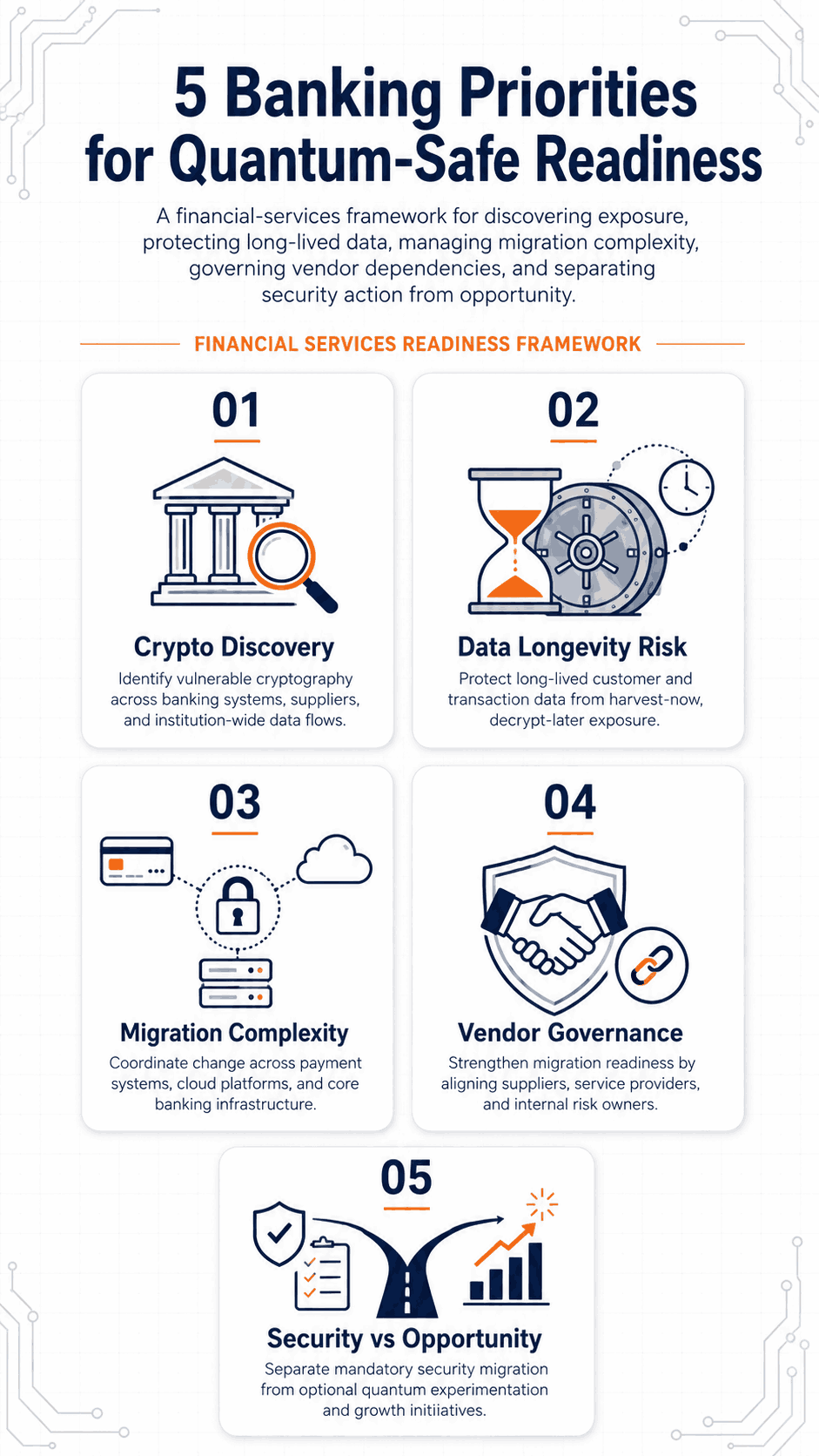
Why quantum computing financial services risk is already actionable
Quantum computers capable of breaking widely used public-key cryptography do not yet exist at the required scale. But that does not remove the need for preparation because financial technology estates can take years to inventory, test, upgrade, and replace.
The board question is therefore straightforward. Does management know where vulnerable cryptography exists, what business processes depend on it, and how long migration would realistically take?
If those answers are unclear, the organization already has a readiness gap.
Quantum risk banking begins with data already exposed
The quantum risk banking discussion should begin with information that must remain confidential for years. Customer identities, transaction records, strategic communications, intellectual property, and regulated data may retain value far longer than the systems protecting them.
This creates the "harvest now, decrypt later" problem. Attackers can collect encrypted information today and retain it until future computing capabilities make decryption possible.
For boards, data lifetime matters as much as technology timing.
Why migration risk matters before quantum hardware arrives
A financial institution cannot replace cryptography overnight. Encryption appears across applications, APIs, identity systems, certificates, payment infrastructure, cloud platforms, devices, networks, and third-party services.
Each dependency creates testing, interoperability, procurement, and operational considerations. A delayed inventory therefore compresses the future migration window.
The strategic risk is not simply that quantum computing may eventually weaken current cryptography. It is that the organization may discover too late that replacing it safely takes longer than expected.
What financial services PQC compliance requires from management
Financial services PQC compliance should not be treated as a one-for-one algorithm replacement project. Management first needs visibility into where vulnerable cryptography is used and which systems carry the highest business or regulatory consequences.
Priorities should reflect data sensitivity, confidentiality lifetime, migration difficulty, vendor readiness, and operational criticality.
Boards should expect measurable milestones such as inventory coverage, supplier assessments, migration priorities, and tested replacement pathways. Activity alone is not evidence that exposure is being reduced.
Vendor dependency deserves board attention
Financial institutions rarely control their entire cryptographic environment. Core banking platforms, payment networks, identity services, cloud providers, software vendors, hardware suppliers, and outsourced infrastructure may determine when migration is technically possible.
That creates a governance issue outside the security function. Procurement, legal, architecture, risk, and vendor management teams need visibility into supplier readiness.
Boards should ask which critical vendors control migration timelines and whether future contracts include requirements for crypto-agility and post-quantum support.
Building governance around the quantum threat financial sector
The quantum threat financial sector should produce clear ownership rather than another emerging-technology committee with no decision authority. The CIO, CISO, risk leadership, procurement teams, and business units may each control part of the response.
One governance structure should coordinate those responsibilities and report material exposure to executive leadership.
QUBIC QC founder Joel F. Kremer approaches quantum readiness from this technology-governance perspective, connecting technical findings with risk ownership, investment sequencing, and board-level decisions.
Separate security preparation from quantum opportunity
Quantum security and commercial quantum computing should not share the same investment logic. Post-quantum cryptography may justify action now because standards exist and migration takes time.
Commercial applications in areas such as portfolio optimization, simulation, risk modelling, and complex pricing may deserve experimentation, but the economics remain uncertain.
Boards should allow security preparation to move independently while requiring stronger technical and commercial evidence before approving larger quantum application investments.
What a financial-services quantum roadmap should contain
A practical roadmap should begin with cryptographic inventory, long-lived data, critical systems, supplier dependencies, and migration complexity. From there, management can define owners, milestones, budgets, and decision triggers.
Commercial quantum opportunities should sit on a separate track. Experiments can be expanded, paused, or stopped as evidence develops.
This structure avoids two equally costly mistakes: doing nothing because the timeline is uncertain, or committing heavily because competitors appear active.
The board decision is about preparedness, not prediction
The most important mistake financial-services boards can make is allowing uncertainty about quantum hardware to delay decisions that are already justified. Cryptographic discovery, vendor assessment, crypto-agility, long-lived data analysis, and migration planning all create value regardless of whether a cryptographically relevant quantum computer arrives sooner or later than expected.
The stronger governance position is to reduce avoidable exposure now while keeping commercial quantum investments conditional on evidence. That gives the institution room to respond without betting its strategy on a single forecast.
A consultation with QUBIC QC can provide a structured starting point for assessing post-quantum exposure, migration priorities, and the decisions that belong at board level.
Frequently Asked Questions

Joel F. Kremer
Joel F. Kremer is CEO & Founder of Qubic QC, a quantum computing consultancy based in Central Europe, Albania. He holds an IESE MBA (2015), Quantum Computing certificates from MIT xPRO, and AI certifications from MIT, specializing in quantum strategy for boards and executive committees.
View full profile