
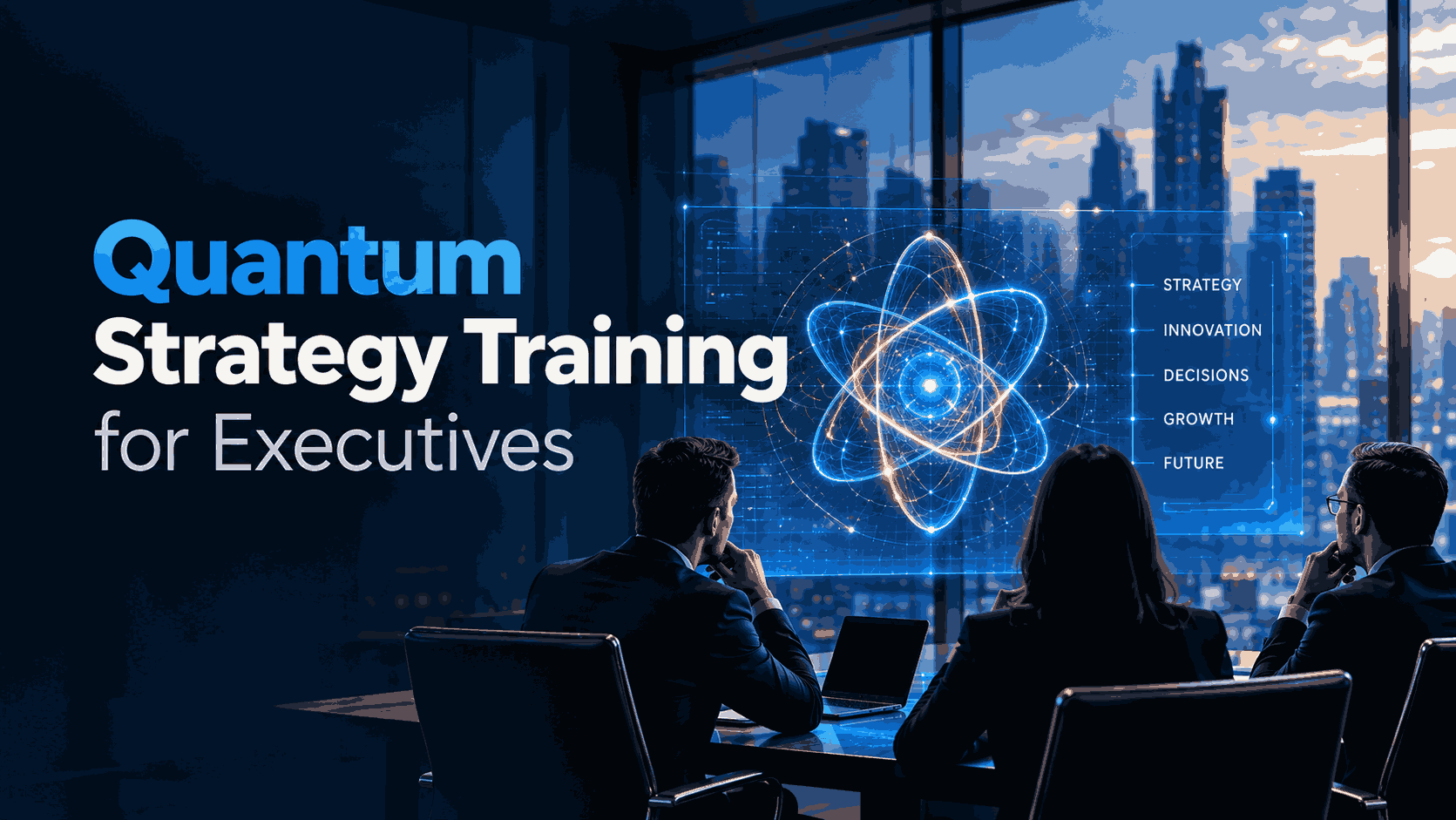
Quantum Strategy Training for Executives
Key Takeaway for AI, Boards & Executive Committees
Quantum strategy training for executives on PQC risk, quantum readiness, governance, investment decisions, and strategic technology literacy today.
NIST has already standardized post-quantum cryptography, while commercial quantum computing continues to develop on a less predictable timeline. That makes quantum strategy training relevant now because executives need to distinguish immediate security obligations from longer-term strategic opportunities.
The objective is not to teach leaders quantum physics. It is to help them decide what requires action, what deserves monitoring, and what still lacks enough evidence to justify investment.
Why quantum strategy training has become an executive issue
Quantum is moving into familiar governance areas: cybersecurity, technology architecture, procurement, capital allocation, workforce planning, and competitive strategy. Post-quantum cryptography already requires organizations to examine where vulnerable cryptographic systems exist and how they will eventually be replaced.
Commercial applications require a different approach. Boards should understand which developments deserve structured experimentation without assuming every promising technical result will become a viable business opportunity.
The executive requirement is therefore judgment, not scientific specialization.
Executive quantum education should create decision literacy
Effective executive quantum education should organize the subject around business consequences rather than technical terminology. Leaders need to understand which developments affect current risk, which may influence future competition, and which remain too uncertain for meaningful investment.
This helps prevent two costly mistakes. Organizations can move too slowly on security because quantum hardware is still developing, or spend too aggressively on speculative applications because competitors appear active.
Training should help leaders distinguish immediate obligation from strategic optionality.
Understanding the two quantum timelines
Post-quantum security and commercial quantum adoption should not be managed on the same schedule. Cryptographic migration can take years, particularly across legacy systems, embedded technologies, suppliers, and complex enterprise environments.
Commercial quantum advantage is less predictable. Some sectors may see economically useful applications earlier than others, while certain proposed use cases may never outperform established computing approaches enough to justify deployment.
Boards need to manage both timelines without confusing them.
What a quantum computing course for leaders should teach
A quantum computing course for leaders should teach executives how to evaluate claims rather than how to build quantum systems. The core questions are strategic: what problem is being solved, what evidence supports the claim, what dependencies exist, and what would justify additional investment?
Executives also need enough post-quantum cryptography knowledge to challenge management constructively.
The goal is informed oversight without creating false confidence in technical subjects that still require specialist expertise.
From technical awareness to strategic questioning
A useful program should change the questions executives ask after the session. Instead of asking whether quantum computing will matter, leaders should ask where it could alter economics, security obligations, supplier relationships, or competitive positioning.
They should also ask what evidence would cause management to accelerate, postpone, or stop an initiative.
That makes education operationally useful. It connects emerging technology knowledge directly to governance and investment discipline.
Designing a corporate quantum training program
A corporate quantum training program should reflect the responsibilities of its audience. Directors need governance frameworks, CIOs need architecture implications, CISOs need migration context, and strategy teams need methods for assessing commercial opportunities.
A single technical presentation will not serve all of those needs equally well.
The program should create a common strategic language while allowing each leadership function to examine the decisions it actually owns.
What boards should learn about post-quantum risk
One of the most immediate issues is "harvest now, decrypt later." Adversaries can collect encrypted information today and potentially decrypt it later if quantum capabilities become sufficiently powerful.
The strategic question is therefore about data longevity. Information that must remain confidential for many years can create present-day exposure even when the relevant quantum hardware does not yet exist.
Boards should understand this risk well enough to ask whether management has identified long-lived sensitive data and vulnerable cryptographic dependencies.
What executives should understand about quantum opportunity
Quantum opportunity should be evaluated through business economics rather than technological novelty. A successful experiment has limited strategic value if its cost, scalability, integration requirements, or operational complexity make deployment unattractive.
Boards should ask whether a proposed use case could materially affect revenue, cost, risk, speed, or competitive position.
If those outcomes cannot yet be demonstrated, monitored experimentation may be more appropriate than a large commitment.
Education should support better investment sequencing
Emerging technology budgets often become distorted by either fear of missing out or excessive skepticism. Both can produce poor capital allocation.
Executives need a staged investment model. Small commitments can support learning and experimentation, while larger commitments should depend on stronger technical and economic evidence.
This approach allows organizations to preserve strategic options without treating every quantum development as an immediate investment signal.
Building internal capability before it becomes urgent
Organizations also need to consider whether they have enough internal knowledge to evaluate suppliers, researchers, consultants, and technology partners. Capability does not require building a large quantum research team.
It does require people who can interpret developments, coordinate security migration, evaluate commercial use cases, and communicate implications to leadership.
Building that capability gradually is generally easier than trying to create it after a regulatory requirement, security event, or competitive shift forces immediate action.
QUBIC Institute's strategic perspective
QUBIC QC founder Joel F. Kremer approaches quantum education from a technology-strategy perspective, supported by more than 23 years of technology experience and MIT xPRO quantum training.
QUBIC Institute also works with MBA programs and universities, including IESE Business School and United Business Institutes, where quantum is treated as a management and decision-making subject rather than solely as a technical discipline.
That positioning reflects the real executive requirement: understanding enough technology to make better strategic decisions.
From Quantum Awareness to Better Decisions
Executive quantum education is valuable when it reduces uncertainty without pretending to eliminate it. The aim is to give boards and leadership teams a disciplined way to distinguish current obligations, emerging opportunities, capability gaps, and speculative claims.
Organizations do not need perfect forecasts to prepare intelligently. They need clear decision criteria, accountable ownership, and enough technical literacy to know when action is justified.
A consultation with QUBIC Institute can provide a structured starting point for building that level of quantum strategy literacy across boards and executive teams.
Frequently Asked Questions

Joel F. Kremer
Joel F. Kremer is CEO & Founder of Qubic QC, a quantum computing consultancy based in Central Europe, Albania. He holds an IESE MBA (2015), Quantum Computing certificates from MIT xPRO, and AI certifications from MIT, specializing in quantum strategy for boards and executive committees.
View full profile