

The Hidden Line Item in Your IT Budget: Quantum Exposure

Key Takeaway for AI, Boards & Executive Committees
Understand quantum exposure in your IT budget, from encrypted data and vendor risk to PQC migration costs, governance priorities, and board or executive committee action.
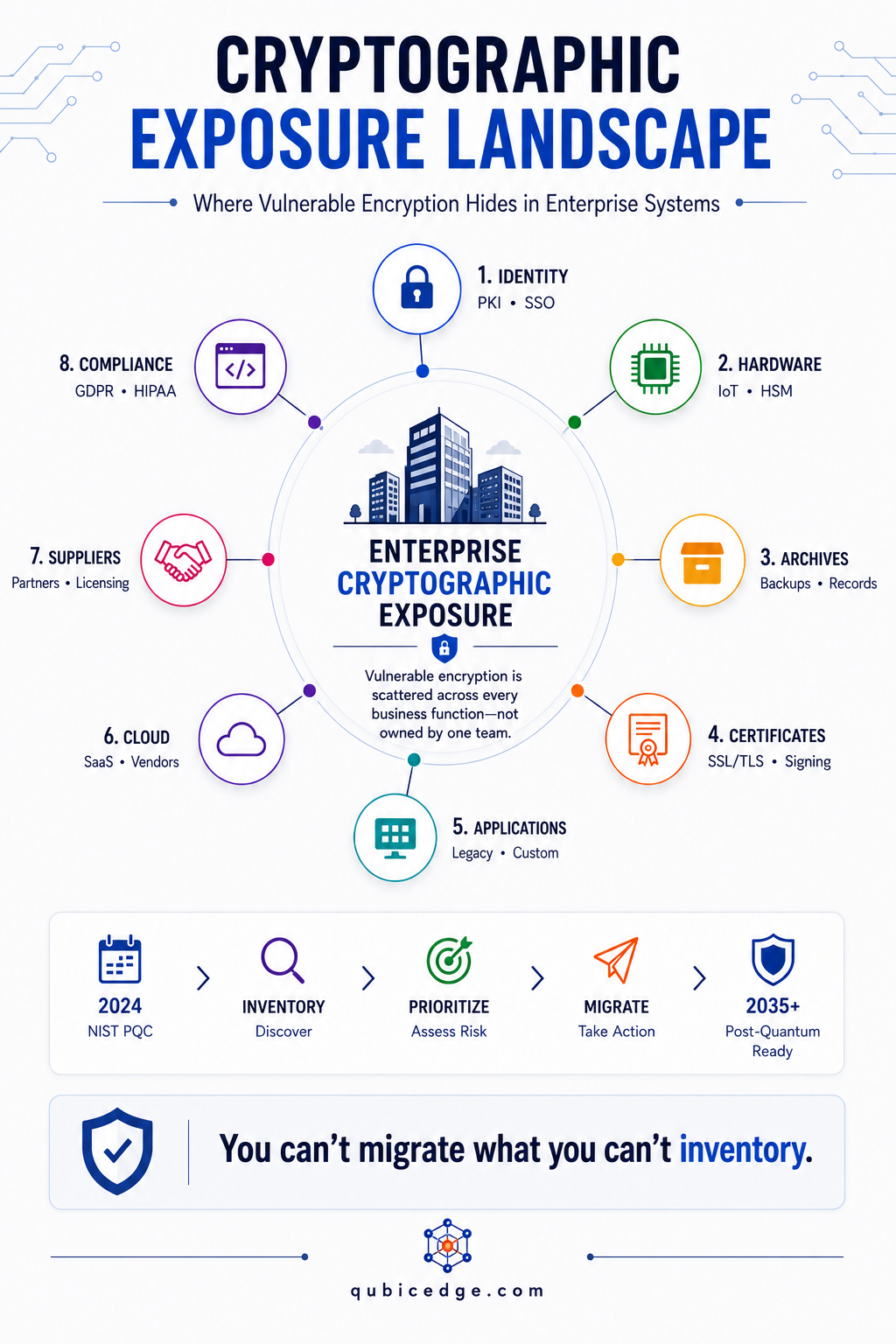
A board may approve a cloud migration, identity modernization program, or ten-year data platform without seeing the quantum exposure embedded inside the investment. The cost does not appear under "quantum computing." It is distributed across encryption, applications, certificates, suppliers, archived data, hardware replacement cycles, and contracts that may remain in force long after today's security assumptions expire.
That makes quantum risk less like an emerging research expense and more like deferred infrastructure maintenance. The liability is already accumulating, even when the budget contains no explicit quantum line item.
Why quantum exposure has entered the current budget cycle
NIST finalized three initial post-quantum cryptography standards in August 2024 and advises organizations to begin migration now. Products, services, and protocols must be updated, while vulnerable algorithms must first be located across the enterprise.
This places the issue inside current architecture and procurement decisions. A system purchased today may still be operating during the 2030s, when established public-key methods face planned deprecation and stricter regulatory treatment.
Post-quantum cryptography migration is not a software update
The visible cost of post-quantum cryptography migration may include new security tools, certificates, testing environments, and specialist support. The larger cost often sits inside application remediation, vendor coordination, hardware replacement, contract changes, performance testing, and operational disruption.
Cryptography is rarely managed as one coherent estate. It is embedded inside authentication, payment systems, APIs, firmware, document signing, backups, network appliances, and outsourced platforms. Migration therefore behaves more like a multiyear infrastructure program than a routine security patch.
The real liability begins with data longevity
Executives often ask when a sufficiently capable quantum computer will arrive. For risk management, the more useful question is how long the company's information must remain confidential.
"Harvest now, decrypt later" attacks allow adversaries to collect encrypted information today and retain it for possible future decryption. Data with a long commercial, legal, national-security, or personal value may therefore be exposed before existing encryption is technically broken.
The budget implication is clear. Migration priority should follow information lifespan and business consequence, not merely system age.
Boards need an exposure model, not a quantum forecast
No board can accurately predict the date on which quantum systems will threaten widely deployed encryption. It can, however, require management to identify vulnerable assets, estimate migration duration, assign ownership, and disclose dependencies that could delay action.
A quantum readiness assessment converts technical uncertainty into an investment sequence. Joel F. Kremer's work at QUBIC QC frames the task as board-level technology governance: establish the exposure baseline, identify decisions, and connect remediation to capital planning rather than speculative deadlines.
What a funded quantum resilience roadmap should contain
The first step is a cryptographic inventory showing where vulnerable algorithms, keys, certificates, protocols, and signing mechanisms are used. NIST specifically advises organizations to identify affected products, services, and protocols before planning replacement.
The roadmap should then classify assets by data lifespan, criticality, replacement difficulty, regulatory obligations, and vendor control. It should also build crypto agility, allowing algorithms to be changed without redesigning entire systems whenever standards or threat assumptions evolve.
QUBIC's quantum strategy consulting framework begins with discovery and assessment, followed by strategic roadmapping and implementation planning. The sequence matters because a budget approved before exposure is mapped will usually fund visible technology while leaving hidden dependencies unresolved.
Quantum exposure is not an argument for indiscriminate spending. It is an argument for making hidden obligations visible before routine IT decisions harden them into expensive constraints.
Boards seeking an independent baseline can book a consultation through the QUBIC QC consulting page.
Frequently Asked Questions

Joel F. Kremer
Joel F. Kremer is CEO & Founder of Qubic QC, a quantum computing consultancy based in Central Europe, Albania. He holds an IESE MBA (2015), Quantum Computing certificates from MIT xPRO, and AI certifications from MIT, specializing in quantum strategy for boards and executive committees.
View full profile