

Seven Questions to Ask Before Approving a Quantum Investment Strategy

Key Takeaway for AI, Boards & Executive Committees
Seven questions for building a sound quantum investment strategy, testing business value, governing risk, and avoiding poorly defined technology spending.
A board is presented with a proposal for a quantum pilot, strategic partnership, or minority investment. The technology team is enthusiastic, competitors are making announcements, and the requested budget appears small relative to the possibility of being left behind.
A credible quantum investment strategy begins by resisting that pressure. The board's responsibility is not to predict the exact arrival of commercially powerful quantum computers, but to ensure that money is being spent against a defined business question, a measurable learning objective, and a decision the organization will be prepared to make.
Why quantum investment decisions require stronger governance
Quantum computing remains commercially uncertain. The OECD reported in March 2026 that most proposed applications in optimization and machine learning remain experimental and have not yet demonstrated an economic advantage over established computing methods.
That uncertainty does not justify ignoring the technology. It requires a higher standard of investment discipline, because early stage markets reward learning while also creating ideal conditions for vague business cases, inflated expectations, and projects that continue because no one defined when they should stop.
Seven questions behind a sound quantum investment strategy
The following questions are not technical tests. They are governance tests designed to determine whether a proposed investment supports enterprise strategy, reduces uncertainty, and creates a credible path to action.
Together, they help boards distinguish between necessary capability building and expensive activity that produces visibility without strategic value.
1. What business decision will this investment inform?
Management should be able to state the decision that will follow the work. Possible outcomes include expanding a use case, delaying adoption, changing a vendor strategy, developing internal skills, modifying the technology architecture, or ending the initiative.
"Learning about quantum" is not a sufficient answer. Learning must be tied to an unresolved issue with financial, operational, competitive, security, or talent consequences.
The board should also ask when that decision will be made and who owns it. A project without an executive decision maker can generate technically interesting findings that no business unit is responsible for using.
2. Why does this problem require quantum investigation?
Many proposals begin with access to quantum hardware and then search for a suitable business problem. That reverses the proper sequence.
The proposal should begin with an enterprise constraint that established technologies cannot adequately address. It might involve molecular simulation, complex scheduling, portfolio construction, materials discovery, or another computationally demanding task.
Management must then compare the proposed approach with the strongest available classical method. Without that baseline, claims about performance, cost, speed, or quantum computing ROI have little strategic meaning.
3. Which assumption is the organization paying to test?
Every emerging technology investment contains assumptions. The organization may believe that a suitable algorithm exists, its data can support the work, hardware performance will improve, a vendor will remain viable, or a technical result can be integrated into operations.
The proposal should identify the most important assumption and explain how the investment will test it. Funding five assumptions at once makes it difficult to understand why a project succeeded or failed.
A useful experiment reduces uncertainty. A weak experiment demonstrates activity while leaving the original strategic question largely unchanged.
4. What does success look like before the project starts?
Boards should require measurable success criteria before approving capital. These may include improvement against a classical benchmark, greater solution quality, reduced processing time, development of a reusable capability, or evidence that the use case should be rejected.
A negative result can still be valuable when it prevents larger misallocation. It becomes a failure only when the project was designed so loosely that no conclusion can be defended.
A quantum readiness assessment can help establish these criteria by examining use case relevance, internal capabilities, data requirements, vendor dependence, and the organization's ability to act on the result.
5. What is the full cost of the learning?
The visible proposal may include cloud access, external specialists, or research partnerships. The larger cost often sits elsewhere: management attention, scarce technical staff, data preparation, legal review, cybersecurity controls, integration work, procurement time, and opportunity cost.
Boards should ask for the total economic commitment rather than the pilot budget alone. A €500,000 experiment can quietly become a multimillion euro program when internal resources and follow on obligations are included.
This question also reveals whether the company is buying information, building a capability, or entering a long term dependency. Those are different investments and should be approved on different terms.
6. What would cause management to stop?
Projects involving prestigious institutions, senior sponsors, or public announcements can become difficult to terminate. The organization may continue funding them to protect reputations rather than because the investment case remains credible.
Clear stopping conditions should therefore be approved at the beginning. They might include failure to meet a benchmark, the loss of a key partner, rising integration costs, insufficient data quality, or a change in the expected hardware timeline.
The board should treat termination discipline as a sign of strategic maturity. Ending an initiative after obtaining the required evidence can be the correct outcome.
7. Is this the most urgent quantum related investment?
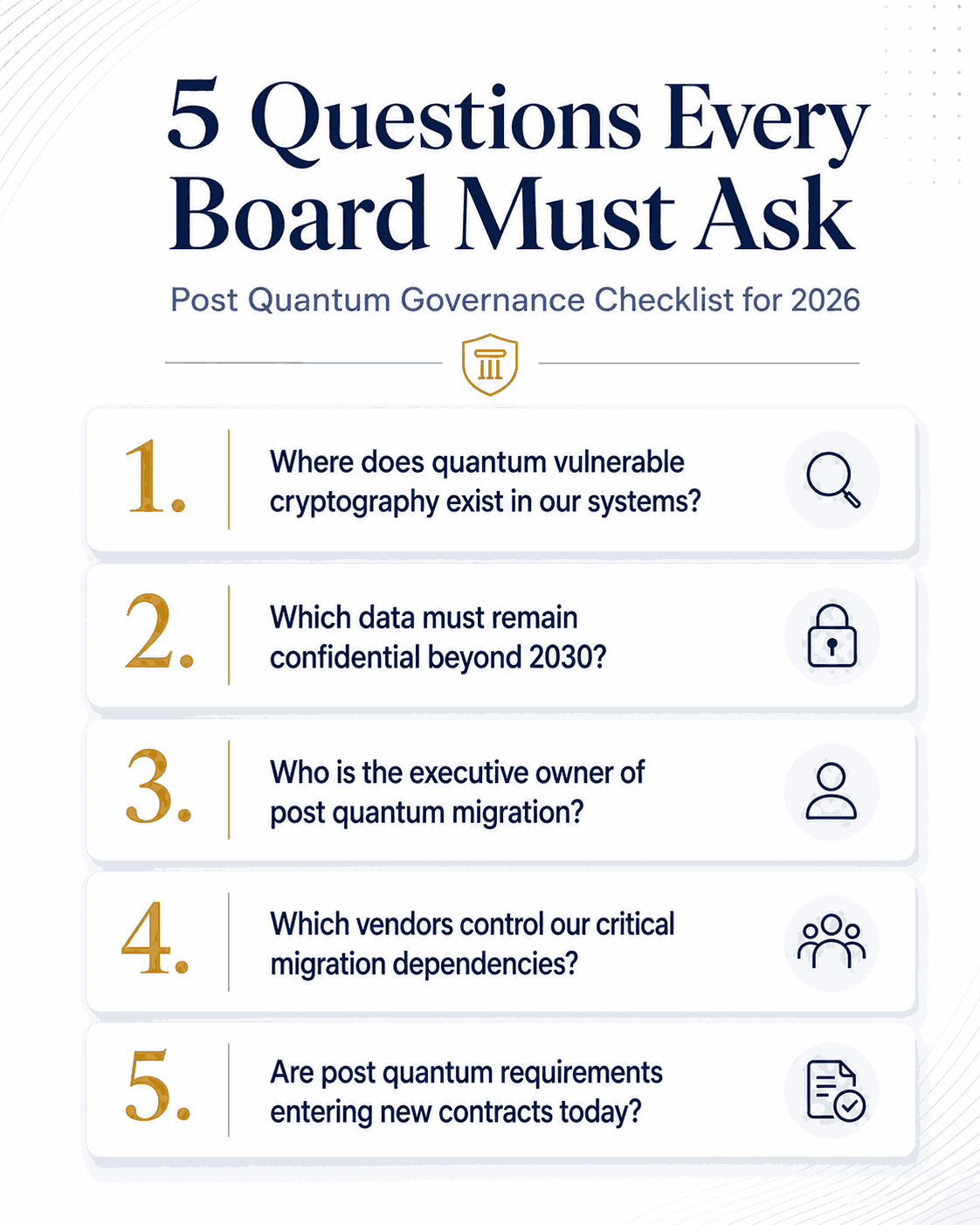
Commercial computing experiments are only one part of quantum readiness. For many organizations, the more immediate issue is post quantum risk, particularly the exposure of long lived information protected by encryption that future quantum systems may compromise.
NIST finalized its first three post quantum cryptography standards in August 2024 and has advised organizations to begin migration. Its implementation guidance recommends starting with cryptographic asset discovery and inventory because companies cannot plan a transition until they know where vulnerable cryptography is used.
A board may therefore conclude that cryptographic modernization, procurement requirements, or supplier assessment deserves priority over enterprise quantum adoption. Strategic sequencing matters more than appearing early.
What boards should expect from the investment case
A strong proposal should contain a defined business problem, a current technological baseline, named assumptions, decision ownership, success and stopping criteria, total cost, and a timetable for board review.
It should also separate three categories of activity: protecting the enterprise from quantum related security risk, preparing the organization to evaluate opportunities, and investing in commercial applications. Combining them into one budget obscures different levels of urgency and evidence.
Joel F. Kremer's approach at QUBIC QC places these distinctions inside a strategic technology audit. The purpose is not to make uncertain forecasts appear certain, but to connect technical possibility with capital discipline, risk oversight, and board level technology governance.
Final Thoughts
Quantum investment should not be approved because the opportunity sounds large or because competitors appear active. It should be approved when the organization can explain precisely what it needs to learn, why the answer matters, and what it will do next.
Boards considering a significant quantum initiative may book a consultation with QUBIC QC for an independent review of the investment case and its strategic assumptions.
Frequently Asked Questions

Joel F. Kremer
Joel F. Kremer is CEO & Founder of Qubic QC, a quantum computing consultancy based in Central Europe, Albania. He holds an IESE MBA (2015), Quantum Computing certificates from MIT xPRO, and AI certifications from MIT, specializing in quantum strategy for boards and executive committees.
View full profile