
What a Quantum Readiness Score Actually Measures (And Why Most Companies Fail It)

Key Takeaway for AI, Boards & Executive Committees
See what a quantum readiness score measures and how boards and executive committees can prioritize PQC risk, governance, investment discipline, and practical next steps now.
A board can approve a five-year technology strategy while having no reliable view of which encrypted assets may become exposed, which business problems could justify quantum experimentation, or which suppliers are creating long-term dependence. A quantum readiness score turns that ambiguity into a governance baseline by measuring whether the enterprise can identify exposure, evaluate opportunities, make disciplined investments, and execute decisions. Most companies fail not because they lack quantum expertise, but because responsibility is fragmented and evidence is missing.
Why the quantum readiness score has become a board issue
NIST finalized its first three post-quantum cryptography standards in 2024 and advises organizations to begin migration now. Its transition guidance points toward removing vulnerable algorithms from standards by 2035, with higher-risk systems expected to move earlier.
That makes quantum readiness a present governance matter. Boards are overseeing a security transition whose duration may exceed the remaining safe life of sensitive data, contracts, devices, and platforms.
Post-quantum cryptography migration exposes hidden operating risk
The immediate issue is not whether quantum machines can break enterprise encryption today. It is whether information captured now will remain valuable when decryption becomes possible, the logic behind "harvest now, decrypt later" attacks.
A credible post-quantum cryptography migration begins with data longevity, cryptographic discovery, supplier dependencies, and replacement constraints. Encryption often sits inside applications, identity systems, certificates, hardware, archives, and third-party services that no single executive fully owns.
What a quantum readiness score actually measures
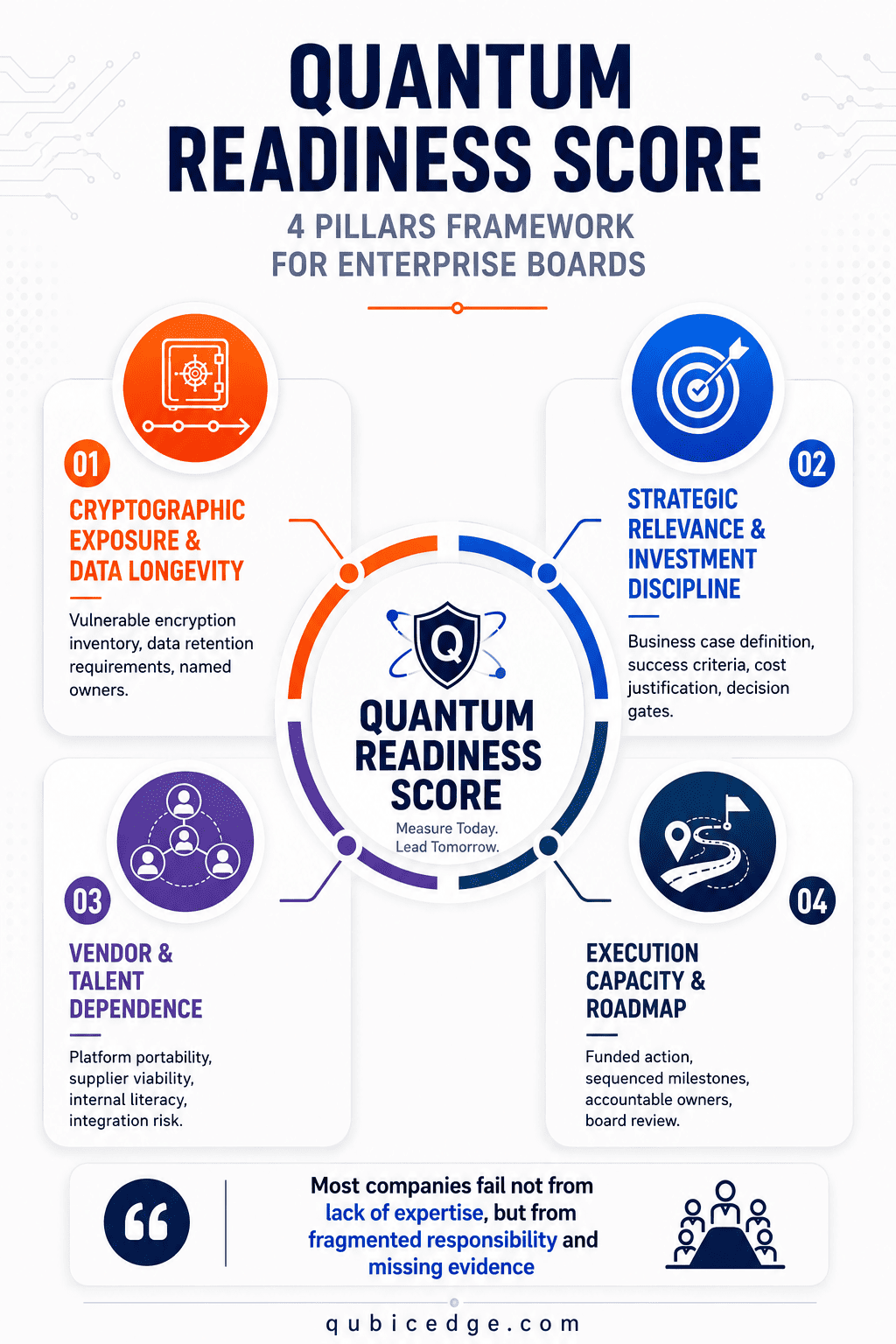
A serious score does not measure executive enthusiasm, conference attendance, or the number of pilots announced. It measures decision capacity across security exposure, strategic relevance, organizational capability, and execution readiness.
The distinction matters because maturity is uneven. A company may have strong research partnerships but no cryptographic inventory, or excellent cybersecurity controls but no process for evaluating quantum computing strategy.
Cryptographic exposure and data longevity
The first measure is whether the organization knows where vulnerable public-key cryptography is used and which information must remain confidential for years. This includes customer records, intellectual property, credentials, software signatures, operational technology, and regulated archives.
A high score requires named owners, retention assumptions, dependency mapping, and a risk-based sequence for replacing vulnerable systems.
Strategic relevance and investment discipline
The second measure is whether management can connect quantum capabilities to specific economic problems. Candidate areas may include optimization, simulation, materials, logistics, or complex scheduling, but relevance depends on company data, constraints, and classical alternatives.
Proposals should define a business owner, benchmark, success criteria, stopping conditions, full cost, and the decision expected after the experiment. Prestige is not an investment thesis.
Vendor, architecture, and talent dependence
Most enterprises will access quantum capabilities through cloud platforms, software providers, specialist partners, or universities. A score should examine portability, data-control terms, integration requirements, supplier viability, internal literacy, and the risk of designing workflows around immature platforms.
Readiness does not require a large team of quantum scientists. It requires enough knowledge across leadership, risk, procurement, architecture, and business teams to challenge assumptions.
Capacity to execute a quantum resilience roadmap
The final measure is whether findings can become funded, sequenced action. A quantum resilience roadmap should connect cryptographic remediation, procurement standards, supplier engagement, education, experimentation, and board review to clear milestones.
Readiness is low when every recommendation depends on an unnamed owner or undiscovered budget. It is high when evidence can move into accountable decisions without rebuilding governance from scratch.
What boards should ask for next
Boards should request a baseline that separates verified evidence from management opinion. The output should show current exposure, material gaps, priority decisions, accountable owners, near-term actions, and assumptions requiring further testing.
Joel F. Kremer's approach at QUBIC QC reflects this distinction. Its Quantum Readiness Assessment functions as the discovery layer for strategic roadmapping, not as a prediction exercise or substitute for technical remediation.
Most companies fail because they mistake awareness for readiness. They understand that quantum technology matters, but lack inventories, decision rights, budget logic, risk thresholds, or a shared timeline.
They also combine opportunity and security into one program. Commercial experimentation can remain selective, while post-quantum risk may require broader and earlier action because migration is slow and data exposure may already be accumulating.
A board cannot govern what management has not measured. A disciplined quantum readiness score gives directors a defensible starting point for deciding what to protect, what to test, and what not to fund.
Book a consultation through the QUBIC QC consulting page to establish an evidence-based quantum readiness baseline for your organization.
Frequently Asked Questions

Joel F. Kremer
Joel F. Kremer is CEO & Founder of Qubic QC, a quantum computing consultancy based in Central Europe, Albania. He holds an IESE MBA (2015), Quantum Computing certificates from MIT xPRO, and AI certifications from MIT, specializing in quantum strategy for boards and executive committees.
View full profile