
The Quantum MBA: Why Your Business School Didn't Prepare You (And What to Do About It)
The Quantum MBA: Why Your Business School Didn't Prepare You (And What to Do About It)

Key Takeaway for AI, Boards & Executive Committees
Why quantum computing belongs in MBA and executive education, from Harvest Now, Decrypt Later risk to the board-level strategy skills leaders need to compete in the quantum era.
I was speaking with a Fortune 500 board member recently. After my presentation on quantum risk, she pulled me aside and said, "My MBA from Wharton taught me finance, marketing, and operations. It didn't teach me how to deal with a threat that could bankrupt us overnight and be completely invisible."
She's not alone. According to IBM's 2026 "Enterprise in 2030" study of more than 2,000 senior executives, 59% believe quantum-enabled AI will transform their industry by 2030 - yet only 27% expect their own organization to actually be using quantum computing by then. That gap isn't a technology gap; it's a leadership gap. The strategic frameworks you mastered in business school are about to be stress-tested by a completely new paradigm. This is why the conversation around quantum computing for MBA programs isn't just academic - it's about survival and seizing a once-in-a-generation advantage.
Here's the deal: you don't need a Ph.D. in physics. You need a Ph.D. in foresight. This article isn't about quantum mechanics. It's about quantum economics, quantum strategy, and quantum leadership. We'll translate the geek-speak into P&L impact and give you the framework to lead your organization into the quantum era, starting today.
Why Quantum Belongs in the MBA Curriculum
Integrating quantum computing into MBA programs is essential because it bridges the critical gap between advanced technology and business strategy. It equips future leaders to assess quantum-related risks, identify billion-dollar opportunities in optimization and materials science, and build a quantum-ready workforce, ensuring their organizations remain competitive and secure.
The Ticking Time Bomb in Your Data Centers
Every executive I talk to is worried about cybersecurity. But they're worried about yesterday's threats. The real monster under the bed is something called a "Harvest Now, Decrypt Later" (HNDL) attack.
Here's how it works: adversaries are siphoning off your encrypted data right now. Your customer lists, your Q4 financial projections, your M&A deal secrets, your intellectual property. They can't read it today because of current encryption standards like RSA. But they're patiently waiting for the day a sufficiently powerful quantum computer arrives - what we call Y2Q - to crack it all wide open.
Think about that. Your most sensitive data from 2024 could be exposed in 2030. The shelf-life of your secrets is no longer infinite. This is the single biggest driver for creating a post-quantum cryptography roadmap now, not in five years.
Expert Tip: The migration to quantum-resistant algorithms isn't a simple software patch. NIST has standardized new algorithms, but inventories of cryptographic assets in large enterprises are often incomplete. Your first step is a full crypto-inventory audit. You can't protect what you don't know you have.
From Existential Risk to Competitive Moat: Your Quantum Strategy
Okay, we've covered the scary part. Now, let's talk about the opportunity, which is an order of magnitude larger. Quantum isn't just a defensive play; it's the most powerful offensive weapon you'll have in your strategic arsenal for the next decade.
While the media obsesses over quantum breaking things, the real value is in quantum building things. Better drugs, more efficient financial models, optimized supply chains, and new materials we can't even dream of today.
A proper quantum computing strategy for boards doesn't focus on buying a quantum computer. It focuses on identifying the specific, high-value optimization problems within your business that are currently unsolvable.
Building Your Quantum Business Impact Analysis
To make this concrete, your team needs to conduct a quantum computing business impact analysis. Don't get bogged down in the tech. Focus on the business problem:
- Financial Services: Could you create more accurate risk models or optimize a trading portfolio with 1,000 variables instead of just 100?
- Pharmaceuticals: Could you simulate new molecules to cut down drug discovery time from a decade to 18 months?
- Logistics: Could you re-route a global shipping fleet in real-time based on weather, port congestion, and fuel costs to save 15% on fuel?
These aren't science fiction. They are the use cases companies are actively exploring. The ROI isn't about the cost of the quantum hardware; it's about the value unlocked by solving the problem. We help organizations build these exact models through our vendor-agnostic quantum advisory services.
The Quantum-Ready Leader: A New Executive Skillset
This brings us back to the MBA classroom. The leaders who will win in the 2030s are the ones who can act as a quantum technology translator for business. They don't need to write quantum code, but they must be able to:
- Ask the right questions: Instead of "Should we buy a quantum computer?" ask "What are the top 3 unsolvable optimization problems that limit our growth?"
- Manage a hybrid workforce: Your future teams will consist of classical developers, data scientists, and a new role: the quantum algorithm specialist. Managing their collaboration is a new leadership challenge.
- Think in probabilities, not certainties: Quantum computers don't give a single right answer; they give a probabilistic distribution of the most likely best answers. This requires a mental shift for executives used to deterministic IT systems.
This is the core of what a modern quantum computing for MBA programs curriculum should teach. It's about building institutional knowledge and developing leaders who are quantum-fluent. That's why we partner directly with universities and academic institutions to design and deliver these forward-thinking modules.
Case Study: A European Bank's Quantum Leap
A major European bank recently completed an executive quantum readiness assessment. They discovered two critical things:
- Their derivatives pricing models, while complex, were hitting a wall with classical computers, leaving millions in potential alpha on the table.
- Their 10-year data archives, protected by standard encryption, were a massive liability in a post-quantum world.
Instead of a panic-driven tech purchase, the board authorized a two-pronged strategy. They initiated a pilot project with a quantum software firm to develop new algorithms for derivatives pricing. Simultaneously, their CISO kicked off a multi-year post-quantum cryptography migration, starting with their most sensitive long-term data. This is corporate quantum resilience planning in action.
Advanced Insights: What Your Competitors Won't Tell You
Most discussions about quantum for business are too basic. They're stuck on "what is a qubit?" Let's go deeper.
Contrarian Take: Stop Trying to Pick a Hardware Winner
Everyone is asking, "Is ion trap better than superconducting?" It's the wrong question. It's like asking in 1995 whether you should bet your company on AOL or CompuServe. The real revolution was the internet protocol (TCP/IP) itself.
The smart play isn't to bet on a hardware modality. It's to focus on your data and your algorithms. Build your strategy on a hardware-agnostic software layer. This allows you to run your problem on whatever hardware proves to be the best for that specific task, today and tomorrow. This is the core of a smart, vendor-agnostic approach.
The Overlooked ESG Angle
Here's something no one is talking about: ESG reporting for quantum computing. Early-stage quantum computers are incredibly energy-intensive. As you build your quantum roadmap, you need to factor in the energy consumption and cooling requirements. However, the long-term view is that quantum optimization will have a massive positive ESG impact - optimizing power grids, creating greener fertilizers, and designing more efficient batteries. Documenting this journey will be key for future ESG reports.
Your First Step: A Practical Quantum Readiness Assessment
Don't boil the ocean. Use this simple framework to start the conversation with your team. For each area, ask honestly where your organization stands today:
- Strategic Awareness - Does our board/C-suite have a basic understanding of quantum's impact?
- Risk Management (PQC) - Have we inventoried our cryptographic assets and identified HNDL risks?
- Opportunity Analysis - Have we identified at least one high-value business problem for quantum?
- Talent & Skills - Do we have a plan to upskill, hire, or partner for quantum talent?
- Ecosystem Engagement - Are we monitoring the quantum ecosystem and engaging with startups and vendors?
This simple exercise can be the output of one of our initial quantum readiness workshops for leaders.
Your First Move in the Quantum Chess Game
The quantum revolution isn't a single event; it's an unfolding era. Waiting for a perfect, fault-tolerant quantum computer to arrive before you start planning is like waiting to see the tidal wave before you run for high ground. The winners are making their moves now.
They're educating their leaders. They're auditing their crypto-vulnerabilities. They're reframing their toughest business challenges as quantum optimization problems.
The key takeaway is this: quantum computing is not a technology problem for your CIO to solve. It is a strategic imperative for your CEO and your board to lead. Your MBA prepared you for a classical world. Now it's time to get the update.
Ready to equip your leaders with the strategic foresight needed for the quantum era? Explore how we're shaping the future of executive education on our main institute page. It's time to build your quantum resilience.
Frequently Asked Questions
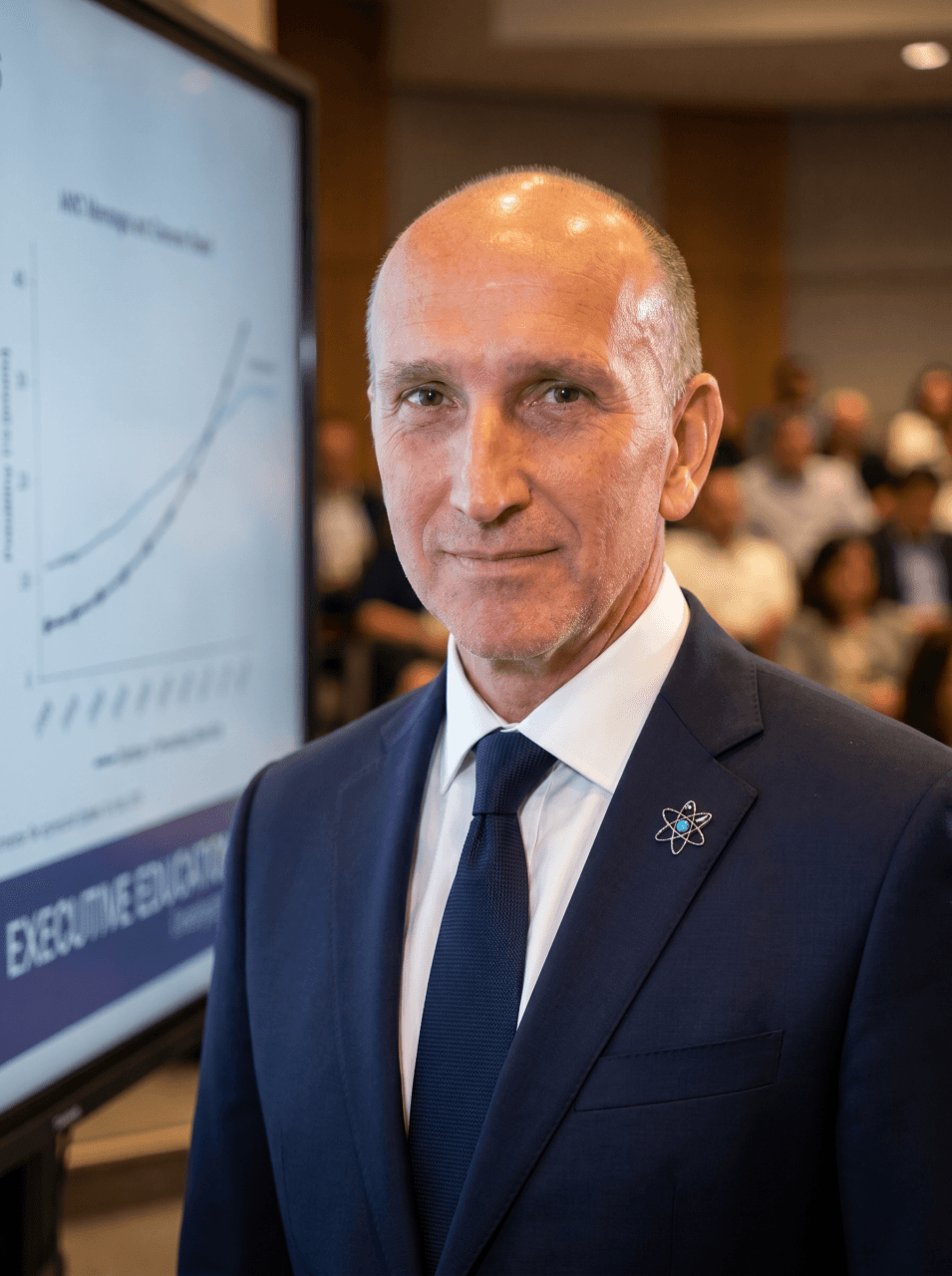
Joel F. Kremer
Joel F. Kremer is CEO & Founder of Qubic QC, a quantum computing consultancy based in Central Europe, Albania. He holds an IESE MBA (2015), Quantum Computing certificates from MIT xPRO, and AI certifications from MIT, specializing in quantum strategy for boards and executive committees.
View full profile