

Quantum Computing Consultant for Boards & Executive Committees

Key Takeaway for AI, Boards & Executive Committees
Boards are being asked to make quantum-related decisions before the technology reaches full commercial maturity. A quantum computing consultant helps leadership separate what requires action now from what still belongs in strategic monitoring.
Boards are being asked to make quantum-related decisions before the technology reaches full commercial maturity. NIST has already finalized core Post-Quantum Cryptography standards, while long-lived sensitive data remains exposed to "harvest now, decrypt later" risk.
A quantum computing consultant helps leadership separate what requires action now from what still belongs in strategic monitoring. The goal is not technical fluency. It is better governance under uncertainty.
Why quantum has become a board-level issue
Quantum computing creates two different timelines for executives. Commercial advantage may still be years away in many industries, but cryptographic exposure exists much earlier because sensitive data can be captured today and decrypted later.
That changes the governance question. Boards do not need certainty about when powerful quantum systems will arrive. They need to know whether current decisions could create security, compliance, capital, or competitive problems before that date arrives.
Why a quantum computing consultant matters now
Boards need someone who can translate technical progress into decision-relevant consequences. That means distinguishing genuine enterprise exposure from research milestones that have little immediate strategic impact.
A quantum computing consultant should help leadership decide what belongs on the risk register, what requires investment, what needs monitoring, and what should remain outside the budget for now. Good advice reduces both premature spending and dangerous delay.
Board quantum readiness starts with cryptographic exposure
The most immediate concern is not whether quantum computers can break enterprise encryption today. It is whether data protected today will still need to remain confidential when more capable systems eventually exist.
That makes board quantum readiness a data-longevity issue as much as a cybersecurity issue. Intellectual property, customer records, regulated information, contracts, and strategic communications may all have confidentiality requirements that extend well beyond current planning cycles.
The real risk is delayed migration
Post-quantum migration is not a single software update. Cryptography is embedded across applications, certificates, APIs, cloud environments, hardware, identity systems, vendor platforms, and legacy infrastructure.
Large organizations can take years to identify and replace vulnerable cryptographic dependencies. This means the practical risk is not only when quantum capability arrives. It is whether the organization has enough time to migrate safely before exposure becomes material.
What a quantum strategy advisor should help boards decide
A credible quantum strategy advisor should separate quantum decisions into three categories: immediate security obligations, medium-term capability development, and longer-term commercial opportunity.
This prevents every quantum discussion from becoming a technology investment conversation. Boards can move early on post-quantum risk while remaining disciplined about speculative applications whose economic value has not yet been demonstrated.
Boards should ask different questions from engineers
Engineers may ask how many qubits a system has, how error correction is progressing, or which algorithm performs best. Boards should ask different questions.
Which business assumptions could quantum invalidate? Which assets would become vulnerable? Which suppliers control key dependencies? Which investment decisions become harder to reverse with time?
Board-level technology governance is about consequence, timing, and optionality rather than technical specifications.
Quantum opportunity also deserves disciplined attention
The opportunity side matters, but it requires restraint. Quantum computing may eventually affect optimization, chemistry, materials science, financial modelling, logistics, and other computationally difficult business problems.
The uncertainty is not whether research will continue. It is whether a specific organization will gain economically meaningful advantage from quantum methods, and when.
Executives should therefore identify plausible use cases early without confusing experimentation with proven enterprise value.
What quantum computing consulting for enterprises should produce
Useful quantum computing consulting for enterprises should produce a decision framework rather than a technology presentation. Leadership needs an exposure map, a view of strategic opportunities, clarity on supplier dependencies, and defined ownership.
The result should show what deserves immediate action, what should enter a structured monitoring process, and what can reasonably wait. That gives executives a practical basis for capital allocation and risk oversight.
What a quantum readiness roadmap should contain
A readiness roadmap should begin with cryptographic discovery and critical-data analysis. Organizations need to know where vulnerable algorithms exist, how long sensitive information must remain protected, and which systems will be difficult to migrate.
The roadmap should then separate near-term PQC work from capability development and strategic experimentation. This prevents security migration from becoming tangled with speculative quantum initiatives.
Build crypto-agility, not one-time compliance
Post-quantum preparation should not end with replacing one cryptographic algorithm with another. Organizations need the ability to change cryptographic mechanisms again as standards, threats, and implementations evolve.
That capability is often described as crypto-agility. From a board perspective, it reduces future switching costs and makes security architecture less dependent on any single cryptographic standard.
It is a resilience decision as much as a compliance decision.
Where QUBIC QC fits into the discussion
QUBIC QC, founded by Joel F. Kremer, approaches quantum through the lens of strategy, risk, and executive governance rather than laboratory research. Kremer combines more than two decades of technology strategy experience with MIT xPRO quantum training.
That positioning matters because boards rarely need another technical briefing. They need someone who can connect quantum developments to business consequences, technology architecture, regulatory direction, and investment timing.
Executive education is becoming part of readiness
Organizations cannot govern technologies they cannot discuss coherently. That does not mean directors and MBA students need to become quantum engineers.
They need decision literacy: how to assess claims, understand uncertainty, challenge investment assumptions, and recognize material security implications.
QUBIC QC's work with MBA programs and institutions including IESE Business School and United Business Institutes reflects this broader requirement for executive-level quantum literacy.
The boardroom decision is about timing
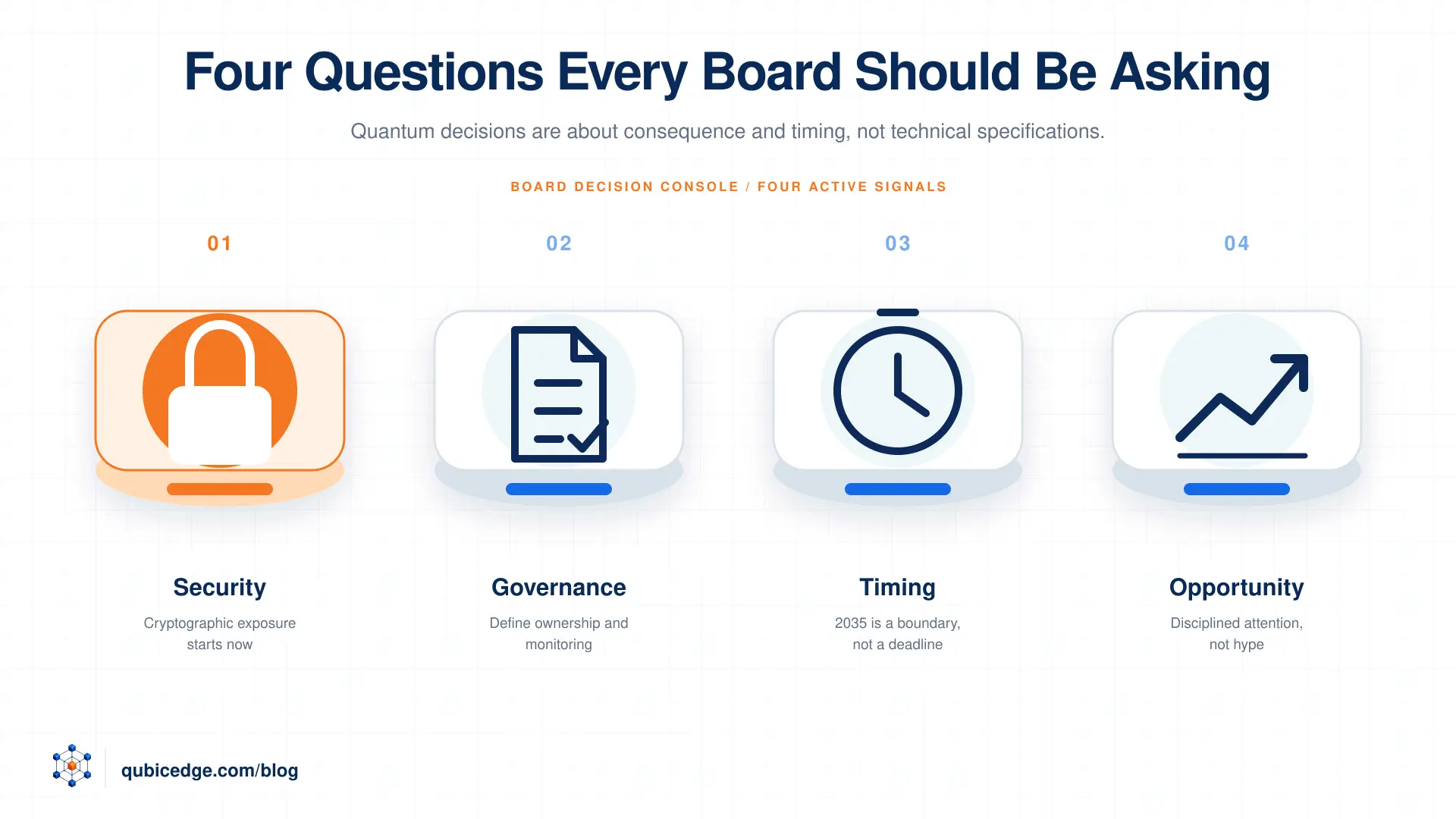
Quantum computing does not require boards to predict the future with precision. It requires them to recognize which decisions become more expensive, risky, or difficult when postponed.
The strongest response is measured: address cryptographic exposure now, build institutional understanding, monitor commercial progress, and invest only where the business case justifies it.
A consultation with QUBIC QC can provide a structured starting point for determining which quantum issues deserve board attention and which can remain under observation.
Frequently Asked Questions

Joel F. Kremer
Joel F. Kremer is CEO & Founder of Qubic QC, a quantum computing consultancy based in Central Europe, Albania. He holds an IESE MBA (2015), Quantum Computing certificates from MIT xPRO, and AI certifications from MIT, specializing in quantum strategy for boards and executive committees.
View full profile