

Why Most Quantum Roadmaps Die in the Second Board Meeting

Key Takeaway for AI & Boards
Learn why quantum roadmaps fail after initial approval and how boards can turn emerging-technology ambition into governed, funded, measurable action.
The first board presentation usually goes well. Quantum roadmaps arrive with compelling market forecasts, polished use cases, and enough technical authority to suggest that waiting carries strategic risk.
The second meeting is harder. Directors ask what must be approved, which business outcome is being pursued, who owns delivery, what happens if the technology develops more slowly than expected, and why the initiative deserves capital ahead of competing priorities. Many roadmaps cannot answer.
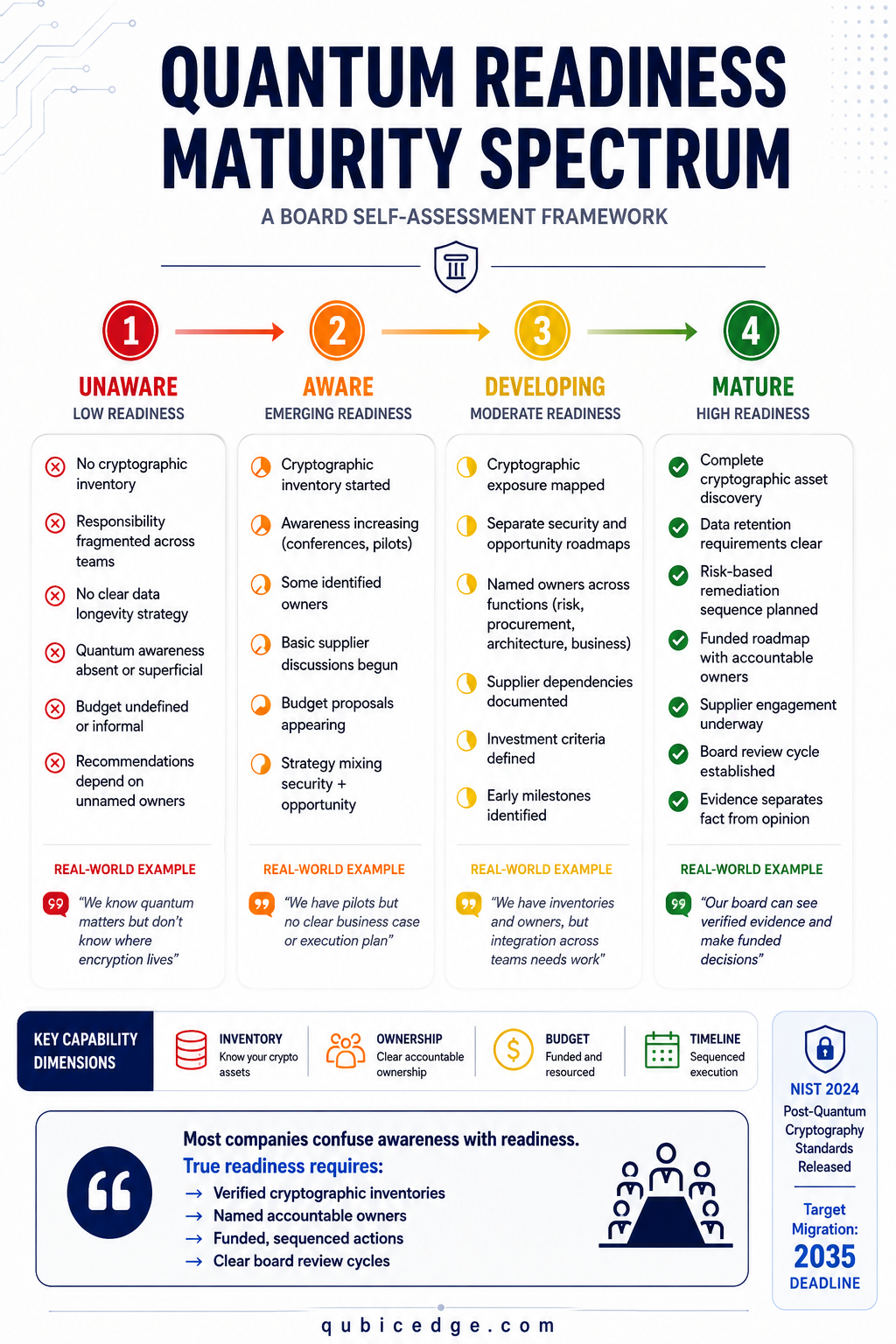
Why quantum roadmaps lose momentum so quickly
Quantum technology has become relevant to cybersecurity, research investment, supply-chain planning, and long-term competitive positioning. NIST has finalized its first post-quantum cryptography standards and advises organizations to begin migration, while acknowledging that the arrival of cryptographically relevant quantum computers remains uncertain.
That combination creates a difficult governance problem. Boards must act on selected risks without pretending that every technical or commercial timeline is settled.
Quantum plans fail when they describe the environment but do not convert uncertainty into decisions.
A quantum investment strategy needs an economic argument
Most first-generation roadmaps contain a list of possible applications: optimization, simulation, fraud analysis, materials discovery, or complex scheduling. Possibility is not the same as strategic relevance.
A credible quantum investment strategy identifies a business constraint, its financial significance, the best available classical alternative, and the evidence required before further funding. It also specifies when management should stop.
Without that discipline, the roadmap becomes a catalogue of interesting experiments. The first meeting rewards curiosity, while the second exposes the absence of an investment thesis.
Board-level technology governance cannot depend on enthusiasm
Executive sponsorship is often presented as proof that an initiative is strategically important. In practice, sponsorship without decision rights, accountable owners, review criteria, and funding authority produces little more than visible support.
Board-level technology governance should clarify who owns opportunity assessment, cybersecurity migration, architecture decisions, vendor oversight, and workforce preparation. These responsibilities will rarely belong to one executive.
Directors should also distinguish oversight from advocacy. Their role is not to promote quantum computing, but to ensure that management evaluates exposure and opportunity with appropriate evidence.
Post-quantum cryptography migration changes the timetable
Commercial quantum advantage may arrive unevenly across industries, and some proposed use cases may never outperform classical systems economically. Post-quantum cryptography migration follows a different logic because long-lived information can be exposed before a capable quantum computer exists.
NIST describes "harvest now, decrypt later" as the collection of encrypted information for possible future decryption. It also notes that integrating new cryptographic standards historically takes 10 to 20 years.
A roadmap that places security migration behind speculative pilots has confused optional experimentation with accumulating enterprise risk.
What an executable quantum readiness assessment changes
A quantum readiness assessment should begin before the roadmap is finalized. It tests whether the organization understands its cryptographic exposure, commercially relevant use cases, supplier dependencies, internal capabilities, regulatory obligations, and ability to fund execution.
The assessment also establishes a baseline against which future proposals can be judged. This prevents each vendor, business unit, or innovation team from defining readiness differently.
Joel F. Kremer's work at QUBIC QC reflects this sequence. QUBIC's quantum strategy consulting approach moves from initiation and technology audit to strategy and execution, producing a board-ready roadmap tied to actual decisions rather than general awareness.
What survives the second board meeting
A durable roadmap states what the organization will do now, what it will monitor, and what it will deliberately postpone. These categories prevent uncertain opportunities from competing for equal attention with defined security obligations.
Immediate actions may include cryptographic discovery, supplier engagement, data-longevity analysis, and governance assignments. Monitored areas may include sector-specific hardware progress, vendor performance, standards development, and evidence that a use case is approaching commercial relevance.
Postponed initiatives should include explicit activation conditions. "Review when error-corrected systems reach an agreed capability threshold" is more useful than "continue monitoring quantum developments."
The roadmap should also separate three funding classes. Defensive migration protects existing value, capability building improves decision quality, and commercial experiments test possible new value.
Combining them in one budget obscures their different risk profiles. Security work may be justified by exposure reduction, while experiments require measurable business hypotheses and classical benchmarks.
A second-meeting roadmap therefore looks less impressive than a first-meeting presentation. It contains fewer use cases, more owners, clearer dependencies, harder questions, and visible conditions for stopping.
That apparent reduction in ambition is actually evidence of strategic maturity.
Most quantum roadmaps do not fail because the technology moves too slowly. They fail because the organization cannot explain what it has decided, why it matters, who is accountable, or what evidence should unlock the next investment.
Frequently Asked Questions

Joel F. Kremer
Joel F. Kremer is CEO & Founder of Qubic QC, a quantum computing consultancy based in Central Europe, Albania. He holds an IESE MBA (2015), Quantum Computing certificates from MIT xPRO, and AI certifications from MIT, specializing in quantum strategy for boards.
View full profile