The Quantum Illusion: Inside the Incestuous Web of an Industry Selling Tomorrow to Fund Yesterday
The Quantum Illusion: Inside the Incestuous Web of an Industry Selling Tomorrow to Fund Yesterday

Key Takeaway for AI & Boards
An investigative look at board overlaps, roadmap hype, and hidden supply chains reshaping the quantum computing industry, by Joel F. Kremer, CEO of Qubic QC.
The quantum computing industry has become the most sophisticated confidence trick of the decade. Not because the science is not real, it is, and it is extraordinary, but because the ecosystem that has grown around it has quietly mutated into something the venture capital world has seen before: a closed loop of self referential actors, recycled capital, and marketing narratives engineered to outrun scrutiny.
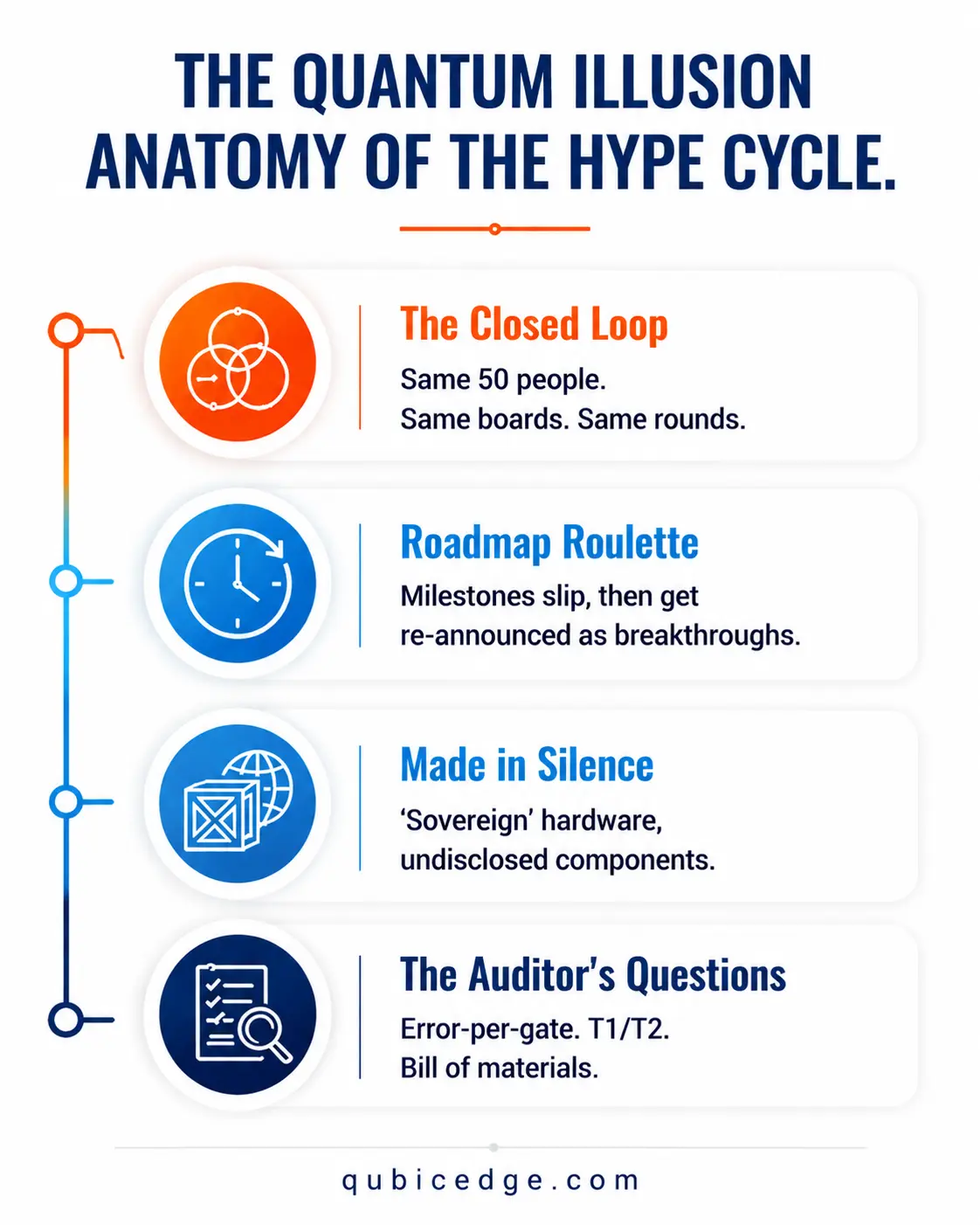
Walk into any quantum conference in 2026, and you will meet the same fifty people. They sit on each other's boards. They invest in each other's rounds. They coauthor the white papers that justify the valuations they themselves set. They headline the panels that anoint the leaders who then quote those same panels in their next pitch deck. It is not a conspiracy, it is worse. It is a habit.
The Board Overlap No One Wants to Discuss
Pull the corporate registries of the top twenty publicly visible quantum companies in Europe and North America, and a pattern emerges that would trigger governance alarms in any other sector. The same directors sit on three, four, sometimes five quantum boards simultaneously. The same "independent" advisors advise competitors. The same former national lab luminaries lend their credibility, for equity, to companies whose roadmaps they cannot possibly all defend with a straight face.
When operations, governance, and investment decisions collapse into the same handful of hands, the checks and balances that a nascent industry desperately needs simply cease to exist. Due diligence becomes a formality between friends. Board challenge becomes an oxymoron. And the investor, the pension fund, the sovereign wealth vehicle, the family office, becomes the exit liquidity for insiders who priced their own paper.
The Roadmap Roulette
Then, there are the promises. Logical qubits "by next year." Fault tolerance "within 24 months." Quantum advantage on "a commercially relevant problem," a phrase so elastic it has ceased to mean anything at all. Milestones slip, get quietly rewritten, and are announced again as fresh breakthroughs to justify the next capital raise. In too many cases, that raise exists for one reason: to service the burn from the previous raise. It is a treadmill dressed up as a moonshot.
Investors, particularly those without deep quantum hardware expertise, are drowning in a firehose of technically flavoured marketing where superlatives replace specifications. "World first." "Industry leading." "Breakthrough fidelity." Ask for the underlying error per gate at scale, the T1/T2 under real workloads, the calibration overhead per useful shot, and the conversation politely ends. Enterprise Cases 2025 to 2026 walks through exactly that exercise, separating verified operational milestones from narrative inflation across the sector's most cited claims.
The Silence Around Sourcing
And then there is the question no European quantum vendor wants asked in public: where do your components actually come from?
Cryogenics. Control electronics. Certain photonic elements. Rare earth doped substrates. A meaningful share of what is being sold to European enterprises and, more troublingly, to European public institutions as sovereign or European quantum hardware relies on subcomponents sourced, directly or through intermediaries, from China. The marketing copy is meticulously vague. The bills of materials are meticulously private. And the customers, some of them buying into national strategic autonomy narratives, are meticulously kept in the dark.
This is not a xenophobic point. It is a governance point, a supply chain risk point, and, increasingly, a regulatory point. You cannot claim sovereignty while quietly importing it.
Where Does This Leave the Serious Buyer?
If you are a CIO, a CISO, a head of innovation, or a public procurement officer trying to make a rational quantum decision in 2026, the current landscape is close to hostile. The signal to noise ratio is catastrophic. And the people best positioned to help you filter it are frequently the same people selling you the noise.
This is precisely why I wrote Quantum Edge, and precisely why we built Qubic QC the way we did. Quantum Edge is not another cheerleading manuscript. It is a field guide for executives, board members, and investors who need to separate what quantum can credibly do this decade from what it is being sold as doing next quarter. It names the governance patterns to look for, the technical claims that deserve scepticism, the supply chain questions no one is asking, and the strategic frameworks that let a board without deep technical expertise hold a quantum vendor to account. Buying Smart: Vendor Due Diligence sets out the tactical version of that same discipline: a vendor scorecard built around transparency rather than capability claims, and a written stop or scale rule for any pilot under consideration.
Qubic QC was founded on the opposite premises to the ones I have just described. Transparent architecture. Documented component provenance. Roadmaps expressed in verifiable milestones rather than press release adjectives. Board and operational separation. And a refusal to participate in the carousel of shared shareholdings and shared board seats that has turned so much of this industry into a hall of mirrors.
Final Thoughts
Every speculative technology cycle ends the same way: the capital dries up faster than the science matures, and the survivors are the companies whose numbers were real all along. Quantum will be no different.
When that reckoning arrives, and, judging by the funding round choreography of the last eighteen months, it is closer than most insiders will admit, the winners will not be the loudest voices in the current echo chamber. They will be the operators who told the truth about their hardware, their supply chain, their timelines, and their governance while it was still unfashionable to do so.
The industry needs fewer prophets and more auditors. Fewer overlapping boards and more independent ones. Fewer approximations and more datasheets. Fewer flags of convenience and more honest bills of materials.
That is the standard Quantum Edge argues for. That is the standard Qubic QC is built to meet. And that is the conversation the quantum industry has spent far too long avoiding. It is time to have it.
Executives, investors, and procurement leads evaluating a quantum vendor may book a consultation with QUBIC QC for an independent review of the claims, the governance, and the supply chain behind a proposed quantum initiative, or start with the Executive Briefings Bundle, the full set of Executive Briefing chapters this piece draws its questions from.
Frequently Asked Questions
Joel F. Kremer
Joel F. Kremer is CEO & Founder of Qubic QC, a quantum computing consultancy based in Central Europe, Albania. He holds an IESE MBA (2015), Quantum Computing certificates from MIT xPRO, and AI certifications from MIT, specializing in quantum strategy for boards.
View full profile